
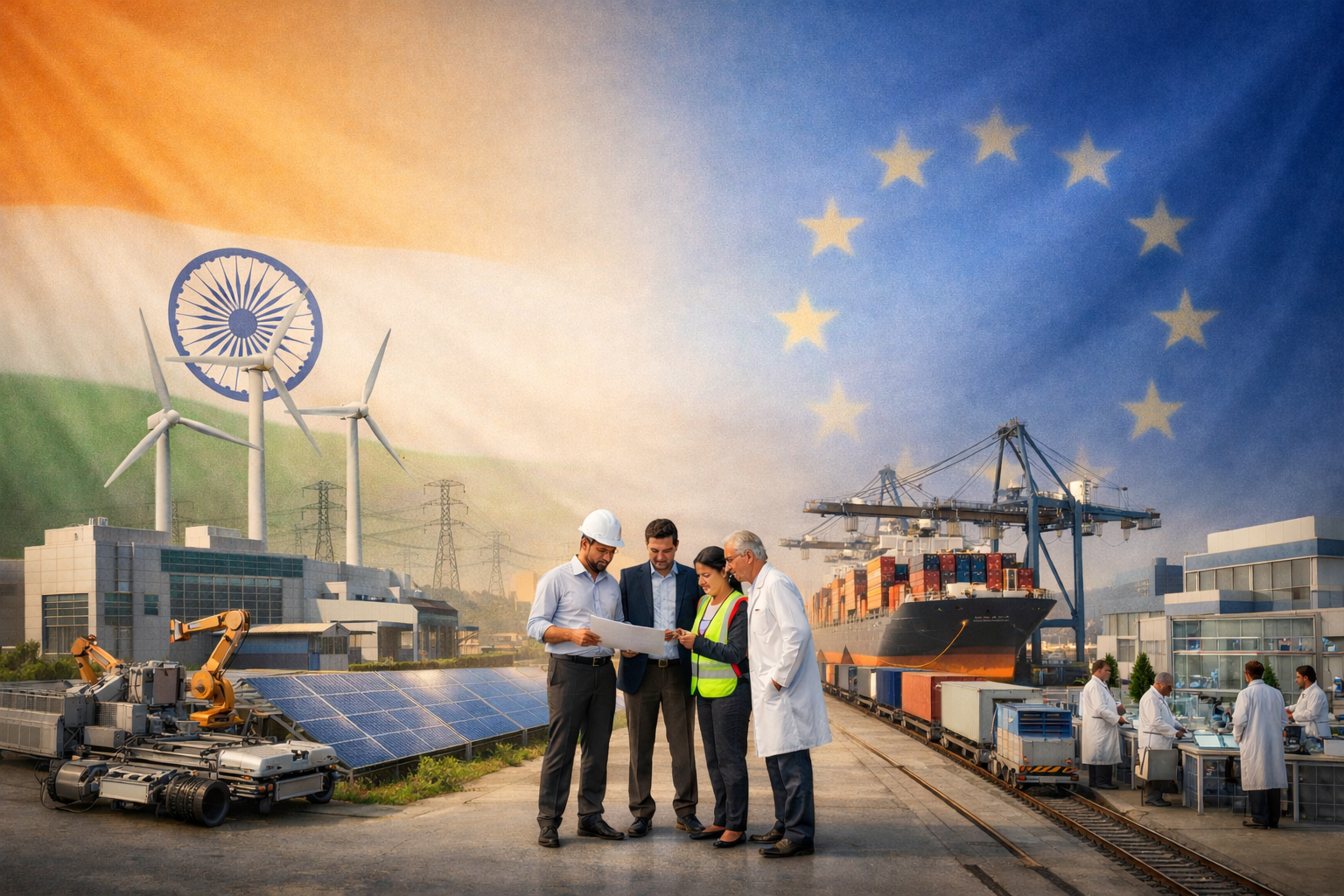
Why This Is More Than a Trade Deal: A Structural Reset for Long-Term Growth

Key Question Facing Leadership Teams Today:
Where should we make our next long-term investment?

Global trade is no longer driven solely by cost efficiency. The operating logic of international commerce is being reshaped by geopolitics, supply-chain resilience, climate commitments, regulatory convergence, and capital discipline. Against this backdrop, the India–Europe trade agreement is emerging not as a routine free trade arrangement, but as a strategic re-anchoring of long-term economic partnerships.

For Europe, India is no longer just a fast-growing consumption market. It is increasingly viewed as a systemically important manufacturing, technology, and innovation hub outside China. For India, Europe is not merely an export destination it is a credibility market, a gateway to advanced value chains, patient capital, and globally accepted standards.

This convergence explains the timing. China+1 strategies are no longer experimental. Supply-chain diversification is now a board-mandated priority. Simultaneously, India’s domestic ambitions, Make in India, Atmanirbhar Bharat, and export-led growth, require precisely the kind of deep, standards-driven integration that Europe offers.

This article explores the implications of the India–Europe trade agreement for businesses, investors, MSMEs, startups, and policymakers, and outlines how firms can turn policy momentum into lasting commercial advantage.

Understanding the Strategic Context: Why This Agreement Matters Now

Trade agreements historically followed economic cycles. Today, they are shaped by strategic risk management.

Europe’s reassessment of China exposure, India’s efforts to move up the value chain, global decarbonisation mandates, and growing regulatory harmonisation have created a unique window of opportunity. This agreement represents both trade liberalisation and a realignment of trust.

Unlike earlier FTAs focused on tariff relief, this deal is designed to:

  • Anchor long-term supply chains
  • Enable high-standards manufacturing and services
  • Encourage investment stability
  • Enforce sustainability and compliance discipline

In essence, this agreement shifts trade from a transactional exchange to structural integration.

How the India–Europe Deal Fits into India’s Long-Term Economic Trajectory

India’s earlier trade agreements were largely transactional. The focus was on tariff concessions, export volumes, and short-term trade balances. The India–Europe agreement signals a philosophical shift.

It aligns with India’s evolution from:

  • Low-cost manufacturing → value-added production
  • Export volume → export quality and compliance credibility
  • Policy incentives → ecosystem-level competitiveness

Make in India now focuses on integrating Indian firms into global value chains, where quality, traceability, and standards drive competitiveness. Atmanirbhar Bharat emphasizes resilient interdependence rather than isolation.

Europe’s regulatory intensity, industrial depth, and sustainability focus make it a natural partner for India’s next phase of growth.

What differentiates this agreement from past FTAs is its depth. It extends beyond tariffs into:

  • Services liberalisation
  • Investment protection
  • Sustainability commitments
  • Intellectual property frameworks
  • Regulatory cooperation

For Indian firms, this agreement not only opens markets but also redefines operating expectations.

Velox Consultants – Decision Intelligence for Cross-Border Growth

We translate macro-policy direction into firm-level market research, opportunity sizing, and growth strategies that align capital allocation with long-term competitiveness.

Moving Beyond Headlines: The Real Architecture of the Agreement

Public discussions often focus on tariff reductions, but for businesses, the most significant implications are elsewhere.

The agreement’s architecture includes:

  • Phased tariff liberalisation across industrial goods, intermediates, and select agri-products
  • Reduction of non-tariff barriers, including customs simplification and conformity assessment recognition
  • Expanded access for services, particularly IT, engineering, professional services, and R&D
  • Investment protection mechanisms to support long-term capital deployment
  • Mandatory ESG, sustainability, carbon reporting, data protection, and labour standards

Many firms underestimate their readiness at this stage.

Access to Europe will depend less on price competitiveness and more on compliance capabilities. ESG disclosures, carbon standards, supply-chain traceability, and data governance are now entry requirements, not future considerations.

While tariff benefits may be phased in over 7 to 15 years, compliance obligations take effect immediately.

Sectoral Impact: Who Benefits, Who Struggles, and Where Value Actually Lies

Not all sectors benefit equally, nor at the same pace.

Near-Term Beneficiaries

  • IT and ITeS services
  • Engineering and design services
  • Specialty chemicals
  • Auto components and precision engineering

These sectors already possess export maturity, regulatory familiarity, and quality benchmarks.

Medium- to Long-Term Opportunities

  • EV ecosystems and battery technologies
  • Renewable energy equipment and storage
  • Advanced textiles and sustainable fibres
  • Pharma CDMO and biologics manufacturing

These align directly with Europe’s decarbonisation, healthcare resilience, and re-industrialisation agendas.

Competitive Pressures

Low-value, commoditised manufacturing and price-driven segments will face greater competition from European imports. Firms that do not improve productivity, quality, branding, and compliance will face challenges.

The real opportunity lies not in entire sectors, but in specific value-chain segments such as battery management systems, biologics APIs, sustainable materials, and precision subsystems.

Velox Consultants – Decision Intelligence for Cross-Border Growth

We convert regulatory and policy frameworks into operational-readiness roadmaps through primary research, compliance benchmarking, and market intelligence.

What the Deal Means for MSMEs: Opportunity with Conditions

A common question from MSMEs is whether this opportunity is realistically accessible.

The honest answer: Yes, but not individually.

Compliance costs, certifications, ESG audits, and scale consistency make solo entry challenging. Successful MSME participation will be:

  • Cluster-led
  • EPC-supported
  • Aggregator-driven

Shared testing infrastructure, pooled certifications, common ESG frameworks, and coordinated export platforms will determine success.

For MSMEs, Europe is not a volume market; it is a catalyst for capability upgrades.

Velox Consultants – Decision Intelligence for Cross-Border Growth

We identify high-value nodes within sectors through granular value-chain analysis, buyer research, and demand validation to guide focused growth investments.

Startups and Europe: From Market Entry to Global Validation

For startups, the opportunity is structurally different.

Europe should be seen not only as a revenue market, but as a platform for validation.

B2B SaaS, climate tech, deep tech, supply-chain intelligence, and industrial AI startups can use Europe to:

  • Validate product robustness
  • Establish regulatory credibility
  • Access strategic investors
  • Enable downstream global expansion

The agreement also increases the likelihood of:

  • Joint ventures
  • Minority strategic investments
  • Technology-led acquisitions

For startups, success in Europe often builds trust with customers in the US, Middle East, and Southeast Asia.

Velox Consultants – Decision Intelligence for Cross-Border Growth

We design market-entry and scaling strategies for MSMEs and startups using buyer discovery, partnership mapping, and regulatory feasibility assessment.

The Overlooked Impact: Consumers, Brands, and Demand-Side Shifts

Trade agreements reshape not only exporters, but also consumers.

Indian consumers will see greater availability of European products, particularly in premium categories. Over time, this will:

  • Raise expectations on quality and sustainability
  • Normalise transparency and traceability
  • Push domestic brands to reposition

For Indian brands, Europe offers something more valuable than revenue: enhanced reputation.

Brand acceptance in Europe enhances global credibility, influencing buyers far beyond the EU.

Velox Consultants – Decision Intelligence for Cross-Border Growth

We track demand-side shifts through consumer research and brand intelligence to help companies reposition offerings for premium and regulated markets.

Why Geography Within India Matters More Than Ever

The benefits of this agreement will not be evenly distributed across India.

States with:

  • Strong manufacturing ecosystems
  • Port connectivity
  • Logistics efficiency
  • Policy readiness

—such as Maharashtra, Gujarat, Tamil Nadu, Karnataka, and Telangana are structurally advantaged.

Emerging states with industrial land and renewable capacity can attract Europe-linked investments if execution improves.

Competition will increasingly occur between states, not just companies.

Velox Consultants – Decision Intelligence for Cross-Border Growth

We support location strategy decisions through regional competitiveness analysis, infrastructure assessment, and investment feasibility studies.

Reality Checks Leaders Must Not Ignore

Every trade agreement creates winners and losers. The risks are material:

  • High compliance and ESG costs
  • Skill gaps in advanced manufacturing
  • Logistics inefficiencies
  • Over-optimistic demand assumptions

India’s past FTAs show that tariff access alone does not generate exports. Firms that entered markets without buyer insight, pricing discipline, or channel strategy did not scale successfully. 

Velox Consultants – Decision Intelligence for Cross-Border Growth

We stress-test growth narratives using primary research, scenario modelling, and execution-risk assessment before capital commitments are made.

What Businesses Should Do Now: A 6–12 Month Playbook

The next year is decisive.

Leadership teams should:

  • Identify Europe-relevant products and services early
  • Initiate ESG, certification, and compliance audits
  • Rework pricing and margin structures
  • Sequence market entry thoughtfully
  • Build partnerships rather than pursue solo entry

Most importantly, firms must invest in capabilities rather than focusing solely on market access:

  • Market intelligence
  • Buyer research
  • Compliance systems
  • Sustainability reporting
  • Brand positioning

Velox Consultants – Decision Intelligence for Cross-Border Growth

We convert policy momentum into actionable growth playbooks supported by market sizing, buyer insights, and go-to-market strategy.

From Policy Opportunity to Revenue Reality

The India–Europe trade agreement is neither a simple solution nor a threat.

It is a filter.

Firms with validated demand, disciplined execution, and compliance-readiness will gain an advantage. Others may struggle even with favourable policy conditions.

Market research, demand forecasting, and buyer profiling are now essential. They determine the difference between a successful entry and a costly exit.

Velox Consultants – Decision Intelligence for Cross-Border Growth

We operate at the intersection of policy analysis, market research, and commercial execution to help firms translate access into revenue.

Velox Consultants – Perspective

At Velox Consultants, we see the India–Europe trade agreement as a long-term structural opportunity rather than a short-term policy catalyst. Success will go to firms that combine compliance readiness, validated demand, and disciplined go-to-market execution.

We support leadership teams in India and Europe with primary market research, competitive intelligence, demand forecasting, and growth strategy, enabling evidence-based decisions before capital is committed and risks become irreversible.

FAQs

1. Is the India–Europe trade agreement mainly about tariffs?
No. Tariffs are only one element. Regulatory alignment, services access, ESG compliance, and investment protection are far more consequential.

2. Which sectors benefit the fastest?
Services, specialty manufacturing, auto components, and engineering services.

3. Can MSMEs realistically benefit from this deal?
Yes, but primarily through clusters, aggregators, or partnerships.

4. How critical is ESG compliance?
Essential. ESG and sustainability are entry requirements, not optional add-ons.

5. What is the biggest risk for Indian exporters?
Overestimating demand and underestimating compliance and execution complexity.

6. Will European imports hurt Indian manufacturers?
Low-value segments may face pressure; upgraded and differentiated firms will gain.

7. How long before tangible benefits emerge?
Tariff benefits phase in over years, but strategic positioning must begin immediately.

8. Why does state-level competitiveness matter?
Infrastructure, logistics, and policy readiness vary widely across India.

9. How should startups approach Europe?
As a credibility and validation market rather than a pure revenue target.

10. How does market research improve outcomes under this agreement?
By validating demand, identifying profitable value-chain positions, and aligning strategy with regulatory realities.



Tags
Market Research Technology Marketing Strategy AI Market Analysis Manufacturing Healthcare Retail Fintech Sustainable Energy Renewable Energy MSME Growth MSMEs in Smart Manufacturing Telemedicine Future Of Healthcare IoT Pharmaceutical Food MSME Clusters Clean Energy Sustainability Metaverse Consumer Goods Automotive Power Sustainability in MSME Digital Twin Industry 4.0 India Smart Factory Market Next-Generation Sequencing Space cleantech net zero by 2030 D2C Healthcare industry Artificial Intelligence Retail Marketing Distributed Energy Resources (DER) Branding Agriculture Infrastructure Global FMCG Trends Data Centres & AI Compute Growth Growth Strategy 2025 Delhi FMCG strategy FMCG India India FMCG Strategy Consumer Insights Growth Strategy agri business models agri-tech innovation Retail Innovation market research for SMEs Healthcare Trends Digital Transformation Green Practises in MSMEs Regional MSME Clusters Advanced Manufacturing smart factory Market research trends AI in market research Predictive analytics Medical Equipment AI in Healthcare Electronic Manufacturing Service Genomic Sequencing CRISPR Gene Editing COP 28 Product Market Fit Strategy DeepTech Quantum Computing Biotechnology Space Mining Satellites Bio-fabrication in Space Wearable medical devices Generative AI green hydrogen production future of hydrogen energy Advantages of Hydrogen for Power Generation Hydrogen Production Hydrogen Policy Cybersecurity Engineering smart mobility Supply Chain Entertainment CPG BFSI zero carbon emission wealthtech Insurtech Neo Bank Online Food Delivery Health and wellness Telecom India Economy 2026 Velox Consultants AI in Manufacturing Atmanirbhar Bharat India Pharma 2026 Green Energy India Semiconductor India Consumption to Capability India Business Strategy Viksit Bharat india-uae-business b2b-growth-strategy global-market-entry middle-east-market cross-border-trade india-export-strategy gcc-expansion abu-dhabi-investment dubai-business-opportunities uae-market-entry Supply Chain Localization Export-Oriented Manufacturing Engineering Goods India Pharma & Chemicals Manufacturing Industrial Policy India 2026 MSME Growth Strategy Manufacturing Investment India Gujarat Industrial Clusters India Manufacturing Corridor India Europe FTA sectors analysis Europe expansion strategy for Indian companies Growth strategy for international market entry Market research for Europe expansion India Europe market entry strategy ESG compliance for Europe exports Data Center Market Research AI Infrastructure Strategy Global AI Data Centers AI Investment & M&A Enterprise Digital Infrastructure India AI Infrastructure Sovereign AI & Policy Power & Cooling Constraints Hyperscale & Colocation Wellness Drinks Functional Beverages Export Market Intelligence Consumer Health Trends Food & Beverage Strategy Preventive Health Nutrition Beverage Industry Trends Gut Health Beverages Ayurveda Export Market Die-Cast Aluminium Market High Pressure Die Casting EV Aluminium Components Export Ready Manufacturing Global Aluminium Supply Chain Low Carbon Aluminium Sustainable Aluminium Manufacturing Manufacturing Capacity Expansion Aluminium Battery Enclosures Lightweight Automotive Materials Advanced Die Casting Technologies Structural Aluminium Castings Large Format Die Casting business growth trade policy impact international market entry strategy manufacturing expansion, export growth opportunities global sourcing shift international procurement tariff disruption strategy export diversification global value chains Autonomous Operations Smart Manufacturing Innovation Acceleration Future of Work AI Strategy Enterprise AI Adoption Autonomous Intelligence Agentic AI Skincare Innovation Digital Cosmetics Clean Beauty Beauty & Wellness Anti-Aging APAC Market Cosmetic Trends 2030 Sustainable Skincare AI in Beauty Satiety Economy FMCG Strategy GLP-1 Supply Chain Innovation Functional Foods Consumer Behavior Supplier and distributor intelligence Vendor Intelligence B2B Market Research Engineering Product Market Research Energy Market Research FMCG Market Research Healthcare Market Research Healthcare & MedTech India 2026 Functional Foods & Agri Innovation Green Hydrogen & Clean Energy Transition EVs & Battery Circular Economy India Semiconductor & Electronics Manufacturing India AI SaaS & MSME Digitization India Investment Opportunities Boardroom Strategy India India 2026 Growth Playbook ClimateTech & Carbon Markets India Healthcare Tech Telecom 6G Telecom 5G EV Mobility AI Chips India Semiconductor Market Semiconductors Green Energy Electricals Automation Emerging Markets Smart Factories Cobots over Robots Energy Reliability Gap Green Electricals Smart Cities Green Transport PM E-Drive Battery Swapping Charging Stations India Mobility EV Infrastructure Electric Vehicles Power sector transformation Smart meters and IoT Energy storage and AI Clean energy transition AI smart grids Farmer Empowerment Rural India Pharma Engineering CMO Insights Velox Ascent Matrix Strategic Consulting for Manufacturers MSME Strategy UAE SME & MSME Consulting Marketing Transformation Tier 2 CPG insights Chennai beauty market trends Ahmedabad regional GTM Personalized Wellness Mumbai CPG personalization Regional Marketing Primary Research CPG Trends 2025 India personalization expert healthtech trends 2030 green hospitals quantum-AI drug discovery bio-digital twins global health trends sustainable healthcare systems quantum AI healthcare regenerative medicine insights digital health innovation Sustainable Growth Business Transformation Retail Growth Strategy Consumer Product Strategy B2B Strategy Growth Matrix Velox Framework Startup Consulting MSME Strategy Functional agriculture nutraceutical exports supply chain in agriculture functional food market wellness foods food-tech sourcing India nutrition economy bio-fortified crops Smart Retail Velox Insights AI in Business Future Of Commerce India Retail Trends Retail Growth 2025 Retail Growth Consumer Intelligence Retain AI Strategic Foresight Zero Defect Zero Effect National Digital Twin Predictive Manufacturing Simulation Tech SME Insights MSME Insights Robotic Surgery Healthcare Technology Minimally Invasive Surgery Surgical Robotics Future of Surgery Healthcare Investments Medical Innovation AI Investment Union Budget 2025 Export Global Business Trends DAVOS 2025 economic resilience Intelligent Manufacturing Sustainable Mobility MSME Export Trends Government Schemes for MSMEs Indian Economy Cloud Computing Smart Factory Technologies Manufacturing Excellence Biosimilars Biologics CRISPR-Cas9 AI in Pharma Pharmaceutical Engineering Pharmaceutical Market Trends Sustainable Pharma Advanced Drug Delivery Real-time insights Digital qualitative research Market intelligence Ethical research AI in Green Finance Blockchain for Sustainability Eco-friendly Investments Sustainable Finance Green Fintech Energy Efficiency Smart Grids Quantum Dots Nanobots Nanomaterials Nanomedicine Nanotechnology Nanofabrication Nano-Fertilizers Carbon Nanotubes Quick Commerce E-commerce Data Driven Personalization Healthcare Innovation MedTech Personalized Medicine Digital Health 3D Printing in Healthcare Robotics in Surgery Carbon Storage System Carbon capture technology Robo Advisor Insurance Finance Banking Biotech CRISPR DigitalTherapeutics Decentralized Finance Contactless Payments Open Banking Traditional Banking Embedded Finance Pharma Innovation Digital Therapeutics Patient Engagement Pharma CX Green Electronics Green Technology Mass Customization Micromobility Vehicle-to-grid (V2G) technology Wireless Charging Battery Advancements Powertrain Optimization Emobility Collaborative Robots Microfactory Bioinformatics Pharmacogenomics Disease Prediction Personalised Medicine Genomics ClimateTech Carbon Capture and Removal Sustainable Transportation Circular Economy Market-Fit Strategy D2C Strategy Human-Machine Interaction Digital Thread Edge Computing Genetic Engineering 3D Bio Printing Space Tourism Aerospace Tissue engineering Organ Transplantation Customised Implants Customised Prosthetics Disease Modeling Regenerative Medicine ECG monitors Wearable health Telehealth Mental health monitoring Fall detection Pregnancy monitors Blood pressure monitors Product Design Content Creation chatgpt WEB 3.0 Invest India India Market startups ESG Electronic Waste Construction Waste Agriculture Waste Water Waste Renewable Energy Waste Plastic Waste Semiconductor Use Semiconductor Transport Surveillance Security Logistics drone technology Innovation Virtual Factory nft ev battery recycling co2 emissions automotive and transporat EV Charging Station Electric Car Charger Charging Car Nordics Robo-Advisor Digital Banking Cloud Kitchen B2B virtualclassrooms elearning education edtech Telemedicine Market Size Telemedicine Market Growth Telemedicine Market Telemedicine Benefits Reshape the Healthcare Internet of Things 3-D Printing Textile Crude Steel Capital goods Automobile Steel Airports Customer Acquisition Tractor IT Pricing Strategy 5 Cs PESTEL Analysis SWOT Analysis 8 Ps